OSD course program

Emotional Integration in Osteopathy

Lecturer: Bruno Ducoux (FRA)

Course facts

Requirements for participation

completed osteopathy training (min. 4 years)

Course fee

Original price was: 680,00 €.Current price is: 544,00 €.

20 in stock

20 in stock

Course details

Course content

Course content

Objectives of this workshop:

  • Developing the ability to perceive and palpate emotional traces in the patient’s body.
  • Transforming emotional wounds into life force that promotes physical and mental health.
  • Experimenting with key concepts such as “vibratory fulcrum” or “tissue stillness.”
  • Discovering inner resources and nature’s resources to effectively overcome fears and resistances.

This advanced training is aimed at practitioners familiar with the fields of tissue and morphodynamics.

Upon completion of the course, participants should be able to:

  • Recognize and interpret emotional traces in the patient’s body through palpation.
  • Transform traumatic emotional experiences into energetic resources that promote health and vitality.
  • Apply key concepts of biodynamic osteopathy such as “vibratory fulcrum” and “tissue stillness.”
  • Utilize internal and natural resources to support the therapeutic process and overcome the patient’s fears and resistances.
  • Integrate knowledge of tissue and morphodynamics into clinical practice.

Content of the advanced training:

  • Integrated relational anatomy – the foundation of osteopathic practice.
  • Sensory perception and afferences – developing sensitivity to body signals.
  • The nervous and hormonal systems in the polyvagal approach – integrating physiology into manual work.
  • Synchronization, tissue stillness, and vibratory fulcrums – tools for working with body and emotions.
  • Verbalization and verbal dialogue – supporting tissue dialogue through communication.
  • Practitioner–patient–environment relationship – a holistic approach to the therapeutic process.
  • Reflective supervision of practice – developing awareness of one’s own work.
  • Answering questions – support and clarification of course content.
  • Knowledge review – multiple-choice test to assess the conveyed content.
  • Clinical internships – the training is predominantly practical and includes: self-work, exercises in water (swimming pool and sea), and in the forest.

Training schedule:

  • Welcome of participants in a dedicated training room.
  • Analysis of clinical cases – discussion of real therapeutic situations.
  • Practical application and evaluation of skills – exercises in the room, in water (if possible), and in nature.
  • Online access to accompanying materials after completion of the training.

Training Plan

Day 1
  • Development of osteopathic concepts; biomechanical, functional, biodynamic, aquatic, and integrative osteopathy. Biopsychosocial approach.
  • Practical application of principles: midline; grounding; relational anatomy.
  • Fascia and extracellular matrix; in-vivo experiments with J.C. Guimberteau.
  • Practical work in pairs.
Day 2
  • Self-perception in contact with nature – exercises to enhance body awareness and perception.
  • The tripartite approach to the nervous system – central and autonomic nervous systems, and water as a “cellular nervous system”; polyvagal context.
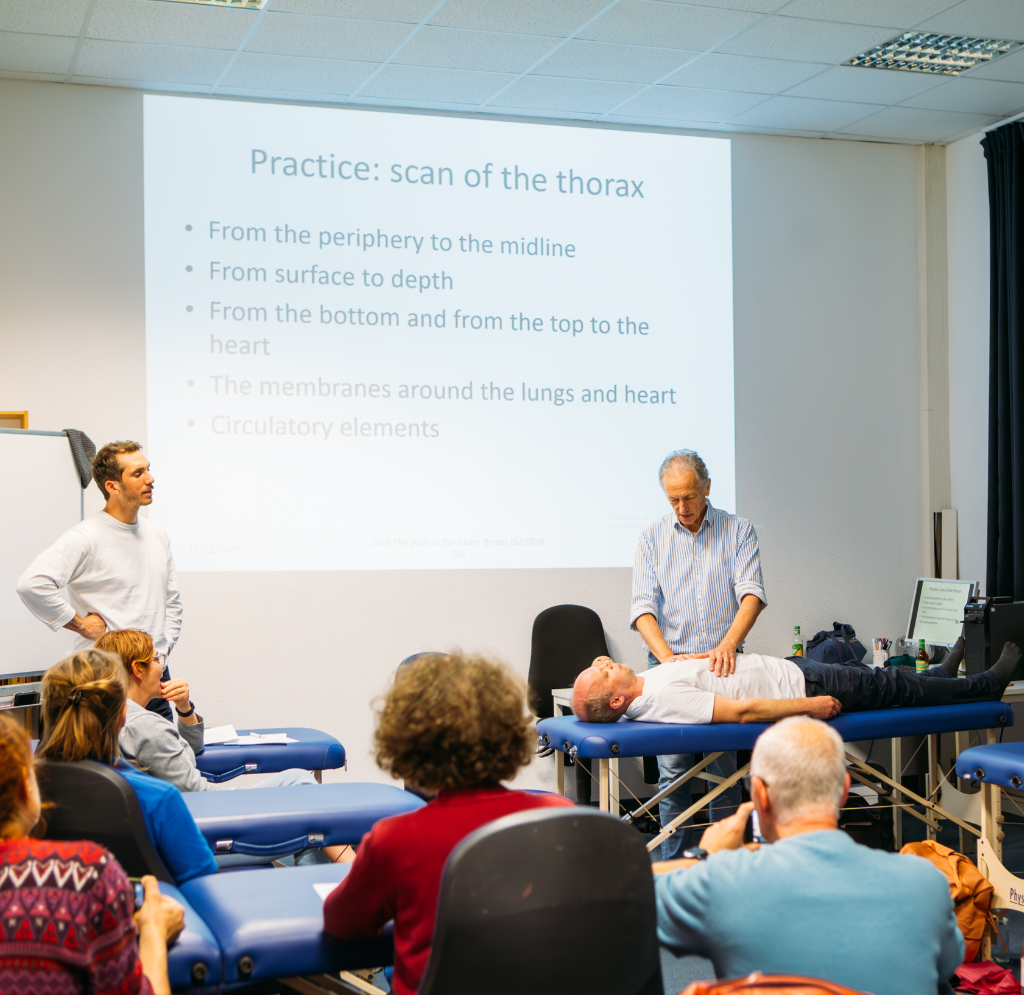
  • Full body scanning practices – developing tactile sensitivity and perception.
  • Vibratory fulcrum, interface, and synchronization – anatomy, physiology, and current scientific research.
  • Connection of the nervous system with the emotional system – latest neuroscientific findings and their practical application.
Day 3
  • Self-perception in contact with nature – exercises to enhance awareness of one’s own body and sensations.
  • The fertility of the somato-emotional concept. Therapeutic pause with the patient.
  • Neutral state of the practitioner.
  • Verbalization and dialogue.
  • Connection with the environment.
  • Global exercises in groups of three, incorporating somato-emotional elements.
  • Global exercises in groups of three – further exercises and integration.
  • Reflective approach to exercises – supervision and participants’ reflections on experiences

Lecturer/s

Bruno Ducoux DO, DPO (FRA)
Private practice of osteopathy since 1984; additional practice at Clinique Saint Martin with newborns since 2002; Master’s degree (Human Sciences) from the University of Tours, France; Member of the French Register of Osteopaths (ROF) since 1985; Founder of the French Academy of Osteopathy in 1997; Editor of the journal “Apostill”; since 2004: Member of the Executive Committee of the “World Osteopathic Health Organization”; International lecturer and teacher in the USA, Canada, England, Spain, Italy, France, and at the OSD. On the board of the European Society for Pediatric Osteopathy.

Course details

Course number

Number 27MC02BD Category ,

Info

Print

Course Information

Other OSD courses

Cookie-Einstellungen